





On your November 3, 2026 ballot, in addition to the state and federal races, you’ll be asked to vote on four separate, but related, questions that came out of Bozeman’s first local government review in 20 years.
Your ballot contains four related questions: one main question on the amended city charter and three related sub-options concerning the structure and election of the City Commission. It is important that you answer all four questions.
It is important to know that the sub-options will only take effect if the main proposed amended charter passes. If the amended charter is rejected, all sub-options fail automatically, even if a majority of voters approve them individually. If approved, the amended charter and any sub-options take effect July 1, 2027, with some provisions phased in through 2029-2030.
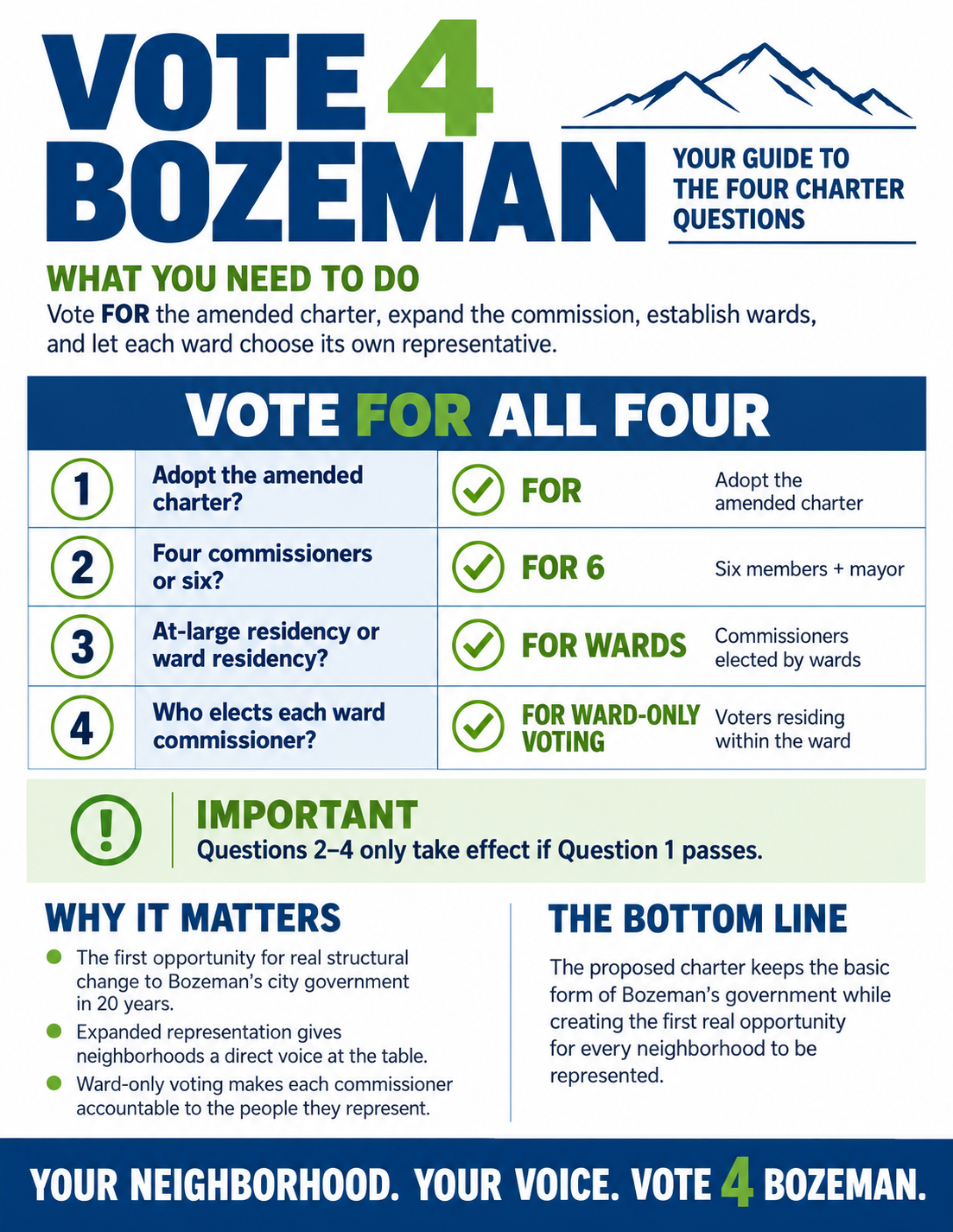
WHAT YOU NEED TO DO: Vote for the amended charter, to expand the commission, to establish wards, and to let each ward choose its own representative.
| # | BALLOT QUESTION | OUR RECOMMENDED CHOICE |
|---|---|---|
| 1 | Existing charter or amended charter? | FOR adoption of the amended charter |
| 2 | Four commissioners or six? | FOR Expanded System: six members + mayor |
| 3 | At-large residency or ward residency? | FOR Commissioners Elected by Wards |
| 4 | Who elects each ward commissioner? | FOR Elected by Voters Residing Within the Ward |
Why This Matters To You
This is the first opportunity for real structural change to Bozeman's city government in 20 years. If it fails, the current system stays in place for the foreseeable future, and so does the disconnect between your desires for Bozeman and what gets decided.
Right now, all commissioners are elected citywide, so no one on the City Commission is specifically accountable to your neighborhood, and your voice is one among tens of thousand that are not being represented.
This matters more than it might seem, because local elections typically see low turnout. Under the current at-large system, that means a well-organized and well-funded voting bloc can, and does, turn out consistently and influences every commission race, leaving many parts of the city without a representative specifically accountable to them, election after election.
If voters approve both the amended charter and wards, Bozeman would be divided into geographic wards. If they also approve ward-only voting, each ward will elect its own commissioner. That means:
- A specific representative for your area. When growth, zoning, or budget decisions affect your street or your part of town, you'll know exactly who to call and who to hold accountable at election time.
- Every part of the city gets guaranteed representation. Wards don't fix low turnout, but they do ensure your part of the city can't be shut out entirely just because another area outvotes it citywide.
- More commissioners, more viewpoints.A larger Commission means there is a greater chance that the City Commission will represent a wider variety of viewpoints, rather than the groupthink we have now.
Why All Four Votes Matter
It is critical that you vote on all four questions. The outcome of this vote has the power to change the future of Bozeman for the better.
The three representation choices are sub-options. They take effect only if voters first approve the amended charter. The choice of who elects ward commissioners also matters only if voters approve wards. DO NOT STOP AFTER THE FIRST QUESTION. Vote on every issue.
The Bottom Line
The proposed charter keeps the basics of Bozeman’s government the same, but when combined with our recommended choices for the sub-options, it overhauls the current system where one voting bloc determines the outcomes of Bozeman’s elections and creates the first opportunity for Bozeman’s citizens to be truly represented.
Ballot Question 1
Adopt the amended charter
ROPOSED AMENDMENTS TO THE EXISTING CHARTER FORM OF GOVERNMENT
Vote for one:
FOR the existing charter established in 2006.
or
(SELECT THIS ONE) FOR adoption of the amended charter proposed for the City of Bozeman by the City of Bozeman Local Government Study Commission in 2026.
What this does
It updates Bozeman’s current 2006 charter without replacing the city’s basic form of government. The city keeps self-government powers, the charter form of government, and the commission-manager structure, where the elected commission sets policy and a professionally hired city manager runs day-to-day operations.
Why vote for it
A vote for the amended charter is not a vote for a new governmental system. It is a vote to retain the existing commission-manager foundation while adopting specific updates created through the government-review process. The most consequential piece isn’t any single provision of the amended charter; it is that this vote is the gateway to the other three. None of the sub-options can take effect unless this passes.
Simplifies the mayor’s role. Currently, an elected mayor spends their first two years in office serving as deputy mayor before becoming mayor for the remaining two years of the four-year term. Under the amended charter, the mayor is elected directly to a full four-year term. The commission would instead appoint a vice mayor from among its own members every two years to fill in when the mayor is absent or if the seat becomes vacant.
Creates a public compensation process. Under the current charter, the city commissioners get to establish their own pay. The proposed charter creates a new compensation board made up of Bozeman residents who will recommend the salaries of the commission and mayor.
Puts public engagement into the charter. A new section of the charter establishes standards for public engagement and addresses neighborhood associations, the Inter-Neighborhood Council, city boards, transparency, and two-way engagement in more detail than the existing charter.
Unlocks the representation reforms. The six-member and ward choices cannot take effect unless the amended charter passes.
Ballot Question 2-4
Sub-Options 1-3
1. Expand the commission to six members
Takes effect only if the amended charter is approved.
Sub-Option 1: Vote for one:
Size of the commission:
FOR Existing System: The commission shall be composed of four (4) members and the mayor.
or
(SELECT THIS ONE) FOR Expanded System: The commission shall be composed of six (6) members and the mayor.
What this does
Bozeman has grown dramatically since the current commission size of four commissioners and the mayor was set, and a larger body spreads representation across more people, and, potentially, more of the city geographically, which matters especially if voters approve wards in Sub-Option 2. Six commissioners means a broader range of backgrounds, experience, and perspectives when making decisions, and if wards are adopted, means wards would be right-sized to adequately represent existing neighborhoods.
Why vote for it
- More viewpoints. Six commissioners adds two new opportunities for viewpoints to be represented that are currently missing from the city commission and reduces the concentration of decision-making power among just a few individuals.
- Better fit for wards. If wards pass, six smaller wards provide more localized representation than four larger wards.
2. Require commissioners to live in the wards they represent
Takes effect only if the amended charter is approved.
Sub-Option 2: Vote for one:
Residency requirements of commissioners:
FOR Existing System: Commissioners Elected At-Large. City commissioners may live anywhere in the City of Bozeman.
or
(SELECT THIS ONE) FOR Commissioners Elected by Wards. City commissioners are required to reside within the ward which they represent.
What this does
Right now, commissioners can live anywhere in the city and are elected by all voters citywide. This sub-option asks whether to divide the city into wards, require each commissioner to live in the ward they represent, and for ward boundaries to be drawn through a public process led by a citizen advisory board. Wards guarantee each part of the city a voice on the City Commission.
Why vote for it
- Geographic representation becomes a rule, not a hope. Every ward has a commissioner who lives there and is elected to represent it.
- Neighborhood knowledge matters. A resident commissioner shares the ward’s streets, growth pressures, parks, traffic, and local concerns. Ward commissioners will understand the specific needs of each neighborhood.
- The mayor remains citywide. All Bozeman voters continue to elect the mayor.
3. Let each ward elect its own commissioner
Takes effect only if both the amended charter and the ward system are approved.
Sub-Option 3: Vote for one:
Method of electing city commissioners if the ward system is approved:
FOR Elected By all Voters: Each commissioner is elected by all voters in the city.
or
(SELECT THIS ONE) FOR Elected by Voters Residing Within the Ward: Only voters whose voter registration address is within the specific ward may vote for that ward’s commissioner.
What this does
A ward is meaningful only when its residents choose its representative. Otherwise, citywide voting blocs can still determine who represents a neighborhood, out-voting the residents who live within the ward. Ward-only voting creates a direct line of responsibility: the ward chooses the commissioner, and the commissioner answers to the ward. True local representation requires direct accountability to the immediate community. Allowing only residents living within a ward to vote for their own representative ensures that ward commissioners remain accountable to their actual neighbors, preventing citywide political interests from swaying local ward representation.
Why vote for it
- Local choice. Only registered voters within the ward elect that ward’s commissioner.
- Direct accountability. Residents know exactly who represents them; the mayor still provides a citywide elected voice.
- Minimizes the impact of outside interests. When ward commissioners are elected by and accountable to the voters within their ward, it reduces the possibility of outside interests influencing how decisions are made.
Facts to Share
Answers to the most common questions
Does the amended charter replace the commission-manager form?
No. The proposed charter retains Bozeman’s charter form, self-government powers, and commission-manager structure.
Do the sub-options count if the amended charter fails?
No. All three sub-options apply only if the amended charter is approved.
Isn’t the new charter enough to bring about change?
No. The new charter offers an improved framework for public engagement, but it lacks teeth. The only way to make sure that your neighborhood’s voice is represented on the City Commission is to also vote for wards and to only allow the people living within the ward to vote for their own representative.
Does choosing wards automatically mean ward-only voting?
No. Question 3 requires commissioners to reside in wards. Question 4 separately decides whether all city voters or only ward voters elect each ward commissioner. Vote on both.
Will the mayor represent only one ward?
No. The mayor remains elected at large by all city voters.
Who draws the wards?
The charter creates a five-member ward advisory board. Members may not be city employees or hold another elected or appointed city position. Its meetings must be public, and it must hold at least two public hearings before finalizing a recommended map.
When would the changes happen?
The approved charter and sub-options become effective July 1, 2027. The transition schedule calls for ward-based elections and the two added commission seats in the 2029 general election.
The four-vote message
VOTE FOR ALL FOUR: AMENDED CHARTER > SIX COMMISSIONERS >
WARDS > WARD VOTERS CHOOSE.
Share this message with everyone you know.